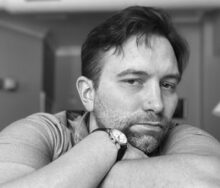
Johnny Compton is a Stoker Award nominated author whose short stories have appeared in Pseudopod, Strange Horizons, The No Sleep Podcast and several other publications. His fascination with frightening fiction started when he was introduced to the ghost story “The Golden Arm” as a child. He is the author of The Spite House, Devils Kill Devils, and Dead First, as well as the short story collection Midnight Somewhere.
Could you tell us a little bit about who you are and what sorts of things you write?
I’m a horror author currently living in Texas, and I write a pretty decent range of scary stories (I like to think so, at least). Some monster stories, some ghost stories, some that are a little more focused on crime and human evil, and some that are harder to categorize beyond just “strange and eerie.” Some are grim, some are fun, some bloodless, and others get pretty gruesome, but for the most part I try to put some emotional weight near or at the forefront.
How did you come to be a writer? What initially inspired you?
You know, I can’t really pinpoint an exact, initial inspiration. I don’t have that Spielberg, The Fabelmans definitive origin of “I saw this movie and it inspired me to recreate something like it immediately.” I know what inspired my love of ghost stories, hearing “The Golden Arm” when I was about five years old. Then I started trying to write somewhere in fourth grade, then tried harder starting in fifth grade, and kind of plucked away at it from there.
So many weird things (meant as a compliment!) happen in your writing. By that same token, so many of the stories in Midnight Somewhere feel like they were started by a “what if?” question. What roles do weirdness and the “what if” question play in your writing?
Compliment taken! “What if” plays a significant role in conceiving ideas, as well as the questions of “Why,” or “What happened?” I remember when I was much, much younger, back in 1996 or so, when Stephen King’s Desperation came out. Either in the notes for that book, or in some interview, he mentions that the idea for that novel came from him riding through a desert town and seeing no one outside, and wondering “What happened to everyone?” Then the idea hit him, “The sheriff killed them all.” When I read that, I thought, always ask questions whenever you see something even slightly unusual, and then answer them, and you’ll never run out of ideas.
That’s not even the sole source of my ideas. There are stories in Midnight Somewhere inspired by dreams, or inspired by other works of fiction. For some stories, I can’t quite remember what inspired them. But there are some stories like “I Caught a Ghost in My Eye” that are born from me catching a speck of dust in my eye, like anyone else, and wondering, “What if it wasn’t just a speck of dust?” Then answering the question with something hopefully frightening and imaginative.
What do you look for in horror? Either when you’re writing it or watching/reading it?
I can get a kick out of a lot of types of horror. Sometimes it’s a well executed, grisly kill, or a particularly creepy setup that doesn’t pay off until later, or a line of dialogue that makes something I read or saw earlier even more horrific. I think what I look for and love most is any sign that the person creating the horror has genuine affection and respect for the genre. Then next, indication that the storyteller has the skill to execute their idea, however they see fit. Even when I don’t necessarily connect with someone’s story, or it’s just not my cup of tea, if I get the sense that they’re committed to it and applied their talent to the best of their ability, I’ll typically find something to admire in it. Conversely, when it just feels like it was more or less phoned in for one reason or another, I have a stronger dislike for it.
It’s hard to say what I look for in my own writing regarding horror because I approach every story a little differently, depending on what I feel like the story needs, but at minimum I’m trying to apply those same “rules” I have for others to myself.
Midnight Somewhere is a collection of some truly strange and fascinating tales. How did this collection come about? Did you have a process or a plan for how your organized these stories?
I got my start with writing short stories and have a lot of affection for that format. About half of the stories in the collection were previously published, but don’t reflect most of my earliest, accepted stories. I could have put together a collection entirely of previously published work but wanted to give readers some new material as well. I’ve been wanting to put a short story collection out basically since The Spite House, my first novel, came out, just to show my love for the short story since that’s the foundation for my writing career.
I tried to organize the stories based on tone and length, never overloading the reader with the longer stories, or with the darker ones. At the same time, I wanted things to have a certain flow. I didn’t want to throw a lighter story in right after the bleakest one, for instance. So I tried to have them blend well.
One theme that I kept picking up on when reading these stories was hubris. Quite a few of them feature this theme. I’m thinking “The Genie and The Inquisitor,” “The One,” “When You Put It That Way,” for example. Is this a theme you think about a lot?
Looking back on the stories you mentioned, and even on my novels, it probably is a theme that’s on my mind a lot, but not consciously. But it’s a pretty interesting theme to explore, which is likely why I keep coming back to it, because I think overconfidence to the point of obliviousness is an easier trap to fall into than a lot of us might think. It’s distinct from arrogance, which has a measure of rude superiority, or unearned confidence attached to it. That can apply to instances of hubris, as well, but not necessarily all, and I think that’s the case for most of my hubristic characters. They have legitimate reason to believe, based on their past successes, that certain things will work out for them. It’s an understandable blind spot that proves harmful and sometimes fatal in the situations I write about.
What’s next for you? Do you have any projects coming out soon, or are you working on anything new that you can talk about?
I have a few things on the horizon. On February 10th, my third novel Dead First comes out. It’s a detective noir / horror thriller that I can hardly wait for people to read. Later in 2026 (no date set yet) I should have a sci-fi horror novella coming through Shortwave Media titled Chimera Skin. I’m also editing an anthology published through Titan that should come out in 2026, titled Where Devils Stand.