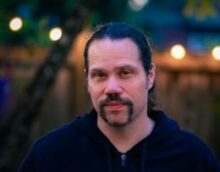
Michael Wehunt has been a finalist for the Bram Stoker Award, multiple Shirley Jackson Awards, and the International Association for the Fantastic in the Arts’s Crawford Award. In Spain, his stories have garnered nominations for the Premio Ignotus and Premio Amaltea, winning the latter. He haunts the woods outside Atlanta with his partner and their dog. Together, they hold the horrors at bay. His second novel, Nightjars, was released September 2026.
Thanks so much for taking the time to do this interview. Let’s start with an easy one. What would you like our readers to know about you, your work, and your background?
Thank you for having me! I love Nightmare. Speaking of, here’s a fun fact about me: I’ve only had one nightmare in my life, at least that I remembered upon waking. I’m a pretty quiet person with a busy life, just hiding in the woods, trying to find time to write and appreciate the small joys in life. I grew up in North Georgia, near the bottom of the Appalachians, so there’s a particular dirt under my fingernails and a particular twang in my heart, if not my voice. I write literary horror fiction and always hope that the word literary doesn’t come across as pretentious. It only means that I treasure words. I’ve published two collections of short fiction and two novels, all within the horror genre.
Your second novel, Nightjars, is pitched as “Memento meets Dracula”—which is a hell of a combination. Did Nightjars start out with those big ideas in mind, or did you find your way there through writing it? What was this book’s genesis like?
My editor first thought of the Memento comparison, but the idea of lost and unreliable memories was there from the beginning, filtered through a camera lens because “pictures don’t lie.” That was the first seed, along with the buried trauma that the book grew out of. The reason one might think of Dracula (to be vague about it) came a bit later, after I gave up on an initial vision that was honestly too grim and too bleak. Probably too experimental, as well.
It was my first time cutting a big chunk of a novel and tossing it in the recycle bin, which was scary, but then I found my way to the true story organically. Though it added a lot of stress to my deadline quest, it was an invigorating and educational experience. I learned a lot about myself and my process, and I feel that the blood of the final novel is stronger and more emotional because of that major plotline I abandoned. I recommend this kind of difficult serendipity at least once in a writing career.
How did your writing and publishing journey change between your debut novel, The October Film Haunt, and Nightjars?
These two books are only a year apart, so Nightjars was nearly done when The October Film Haunt was published. I didn’t know how the latter would fare out in the world and what my takeaway might end up being. But as I worked and reworked, I appreciated how my first novel was informing my second, through commonalities and especially through contrasts. Just the simple fact that Nightjars was my second novel made everything feel different, a little looser. I knew what I wanted to approach differently, and I knew I could write a novel because I’d done it before.
But the most significant change was writing to deadline and under contract. I had written short stories or novelettes by invitation and restricted to a (usually loose) theme, but a novel was an entirely different creature. There is a unique pressure that comes with having to write a 300-page book within a timeframe chosen by someone else. But again, I’m glad for it because it sharpened several skills in my toolbox. I came out of it a better writer and a more efficient one.
You cut your teeth, so to speak, on short fiction before your first novel was published. What was that transition like, and do you have any suggestions for short fiction writers that might want to experiment with a novel or two?
It was daunting! As I think it should be, because writing a novel is far more than just adding things to make a story idea longer. The scaffolding the story is built on is so different. The transition was, first and foremost, learning how to think about that scaffolding before I climbed up onto it. To the prospective novelist, I’d say that the most valuable advice is, unsurprisingly, to read a lot of novels and think about the structures of the ones you love.
And I would go so far as to suggest not reading short stories for a little while, as you prepare and as you write. When I read short fiction, I want to write short fiction, and my brain starts thinking and conceptualizing in short fiction terms. Your mileage may vary, but I personally have to be careful. For example, I learned quickly that ambiguity (or obfuscation that places faith in the reader) can’t have as much free rein in a novel. Short fiction can experiment extensively, but a novel has rules and guardrails along its scaffolding. It needs clarity as it delves deeper and deeper into that larger canvas.
I think craft books like Save the Cat! Writes a Novel can be very useful and are popular for a reason. They can help you build a scaffolding that is rather homogenous but is also proven in the marketplace. But never forget to bring yourself to the process above all else. Write from your heart, not to the market. That’s how your unique voice will stay intact, and that’s what will make the story breathe and bleed.
It also depends on how a short story writer wants to approach the ultimate destination of a novel, i.e., its publication. If self-publishing or a small press is the goal, it’s much easier, and what I mean by easier relates to your novel’s length. In the “Big Five” world, a debut novel in the horror genre (and several other genres) is generally expected to be 80,000 to 90,000 words, as a rough estimate. (Though my debut ended up at 124,000 words, it was sold at a little over 90K.) A truly indie debut novel has a lot more leeway—50,000 words (the minimum to be considered a novel) is fine. 60K is no problem. 120,000 words will face hurdles, but not as many. Planning your word count and wrangling yourself within that word count are important!
As for deciding between pursuing a traditional Big Five publishing path with a literary agent versus publishing with an indie press or entirely on your own, there are a lot of factors to consider. Too many to go into here. But each path is viable, with its own pros and cons.
Both October Film Haunt and Nightjars make found media central to the narrative. What about this storytelling device is so compelling for you? Is there something intrinsically mysterious or creepy in old polaroids and VHS tapes? Does that creepiness lessen when the media is more modern?
Physical media is tangible. You can find it under a floorboard in an abandoned house and hold it in your hand and wonder who—or what—else has held it. There’s implied mystery and history. Books and VHS tapes and cameras are containers, which means they can have something terrifying inside of them. They can transfer those things onto you. Digital media is ephemeral by nature. It could have been made yesterday and doctored to look old. You can scroll past it. Skepticism comes naturally. It just feels like a lesser thing, and every aspect is inherently diminished.
Part of the inspiration for The October Film Haunt was starting with a creepy outdated format like the VHS tape and then transitioning it into modern media. I wanted to answer that very question: Can videos on the internet, instantly shareable, incredibly easy to make and disperse, hold the same level of dread? A video clip on YouTube could surely reach far, far more people than a tape could. I felt that it opened a much wider lens of horror that captured the world we live in now. The analog horror subgenre deals with this kind of warped creepiness a lot, story worlds like Backrooms blending old media formats with new ones. I think it’s a fascinating way to bring urban legends online.
And physical photographs . . . this conceit in Nightjars goes back to that idea I mentioned earlier, that photos don’t lie. A picture is worth a thousand words. “Pics or it didn’t happen.” If you find a physical photograph of yourself in a context that never existed, you at least have to consider whether you could be wrong and the picture could be right. That uncertainty is certainly skin-crawling.
You play with the blurry edges of reality and fiction in your work. In one notable example you turned Trevor Henderson, a well-known artist who you worked with for illustrations in your second short fiction collection The Inconsolables, into a point of view character in The October Film Haunt. What’s the appeal for you in adding these “meta” layers to a story?
The October Film Haunt wanted and needed to be meta horror, in terms of social commentary but even more so by its very nature, what the story was trying to do. I wanted to open a door between folklore and those who create folklore, so that the very idea of belief could be questioned. We live in a post-truth era (and AI is accelerating it), so what better than horror to examine the power of belief outside of fact? (See: the Slender Man stabbings. See: MAGA politics.) So the challenge was where to draw the line between reality and fiction, where to make the line thick and where to make it thin. I namedropped real horror movies and fictional ones, real actors and fictional ones. I felt that a real character mixed in with the made-up ones would take the effect to another level.
In the novel, an artist is responsible for creating the film concept art for an entity known in message forums as the Pine Arch Creature. In my mind, the Pine Arch Creature felt like a Trevor Henderson creation. And since Trevor had mentioned the original October Film Haunt short story on social media several times over the years, I asked him if I could create a fictionalized version of him. Fortunately, he loved the idea, even the fact that [redacted]. It wasn’t so much about realism as it was about interrogating realism.
Without spoiling it, Nightjars offers a quite unique take on vampires. Over 100 years after Bram Stoker’s Dracula, with so many variations from cozy to gory, why do you think vampires continue to resonate with and fascinate writers and readers?
There’s something about vampires that spreads their appeal out across the full spectrum. The sexual allure that’s part of its hunting and feeding habits, in some lore. The brute strength, the taking of what it wants. Its nocturnal nature. Its pure carnality. Its potentially malleable gender. The fact that in most lore, you must invite its darkness inside, which opens up the complexity of temptation. These elements can speak to so many.
For me, the vampire exists in two strange gaps: between animal and human and simultaneously between human and god. That’s about as fascinating as it gets. They get sustenance from fresh blood, yet they’re immortal. They’re far more powerful than we are, yet they’re bound by rules. They project inevitability, yet they hide from the light. They live in a limbo of contradictions.
Were there books or movies that originally drew you to the horror genre?
My rite of passage into horror was pretty standard. I watched The Exorcist when I was seven years old and managed to not have a single nightmare, so I did walk through that door early. Then I read Stephen King’s Carrie when I was eight or nine, and though much of it went far over my head, there was this aesthetic in me that was already drawn to that inscrutable feeling of something being very, very wrong. Before too much longer, I had a huge Freddy Krueger poster over my bed. Anything that made my skin go cold, if only for a few seconds, I wanted it like a drug when I was a kid. I’ve been chasing that feeling ever since.
There are connections and references in your short stories to other short stories and now your novels. How and when do these connections come about in your writing process? Do you have plans for a grand Michael Wehunt Connected Universe?
If I had time to write more short fiction, I’m pretty sure I’d be well on my way to having an expansive story universe with all kinds of connections, most of them branching out from the mysterious occult art collective, Pine Arch Research. But it’s happening to a lesser degree over time. It started with a story called “The Pine Arch Collection,” which I wanted to be a semi-not-really-sequel to my original October Film Haunt story. Then another story latched on from a different angle. Then another. Then the OFH novel affixed itself in the sky like a moon and started a tidal pull that I hope I can stop resisting eventually.
Around a third of the way into Nightjars the book expands from Luke’s point of view to include his ex-wife Kristen as co-protagonist. Had you always intended to give both perspectives and how did you decide where and how to divide the story?
That was always the plan because I wanted to play with point of view. I’m trying to answer this without any spoilers, but I’m fascinated by the thought of reading a longer piece of fiction and then reaching a point of realization that it hasn’t been quite what you thought you were reading. And since much of Nightjars concerns a man who sees himself as an unreliable narrator, that switch enabled me to look at Luke’s reliability from another up-close perspective, that of the person who knows him best . . . or does she?
It felt right to do this at roughly the one-third point, what probably serves as the beginning of the second act. Luke has been put through the wringer, and it was time to examine his story in a new light, while the sun was still up.
With your work now receiving multiple awards and honors, and with two short story collections and two novels on shelves, is there any advice you wish you could give yourself when you were starting out in the field?
I would want to tell myself to write more, but 2026 me would know not to set 2012 me up for failure like that. I’ve always had to scrape together writing time, and I wouldn’t have been able to “quit the day job” to vastly increase my writing output. So instead, I’d tell myself to learn as quickly as possible to stop comparing my bandwidth to others, in terms of publications, author events and traveling, and social media presence. Comparing yourself to your peers is a road to madness. Do what you can with the time you have, and maximize it in the way that feels smart and healthy.
I’m trying to make up for lost time and publish more now, but I try to keep in mind that self-care is a huge part of being an author, especially if you have to write on the side.
What are you working on now?
I’m waist-deep in the third novel now, which will be a Wehunt (or Wehaunt) take on perhaps the oldest horror trope of them all: the haunted house. I was always going to build a story house and put ghosts in it. It’s the holy grail, and I feel this sacred obligation to do it right and soak every sentence in creepy atmosphere.