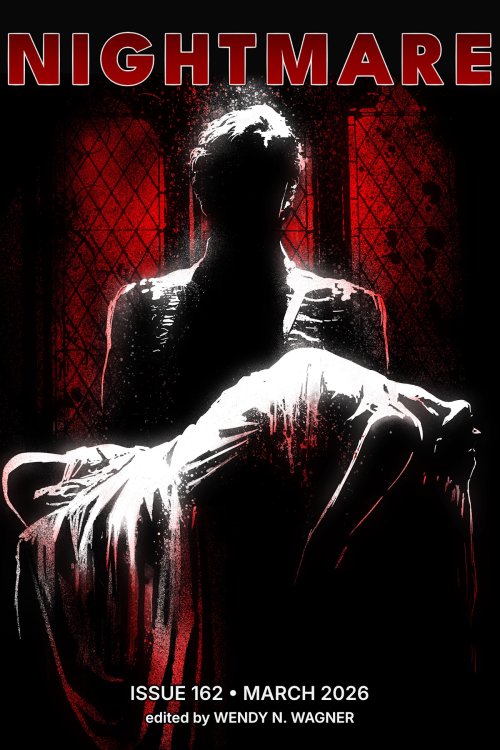
Welcome to issue #162 of Nightmare Magazine!
I had a hard time putting my finger on just what connected the pieces in this month’s issue. I knew they felt good together, the same way that songs on one side of a record might sound good together because they modulate in and out of connected keys. But it took me a little while to realize that each of these works somehow incorporates appearances and seemings.
Our flash story, “The Doll Problem” by Angela Liu? Dolls are the ultimate symbol of the seeming, occupying a space at the edge of the uncanny valley where something looks unbearably close to a human being—and yet is horribly not. A shotgun house, referenced in this issue’s poem (“Zooming Past Shotgun Houses” by Eva Roslin) seems to be see-through, and yet contains its secrets behind closed doors. Adam-Troy Castro’s “Her Dark Places” is a short story about a man who believed he had the perfect wife, but now sees her as a terrifying skeleton. Is there something wrong with him? Is there something wrong with her? Why does her appearance no longer match his experience? (You’ll have to read it and make up your own mind!)
As you read this month’s creative work, you might start out feeling as if Gordon B. White’s new story “Will the Last One to Leave Please Turn Out the Lights” doesn’t fit in with the rest of the stories. It’s a weird (and Weird!) tale set in a revolting kind of apocalypse, and it’s about an animal control officer on a mission to help her neighbor. But I think when you get to the end, you’ll see why it’s a perfect fit.
You can learn more about Gordon B. White’s writing process in the spotlight interview about his piece. Our team also sat down with Adam-Troy Castro to pick his brain. We’ve got great volunteers here at Nightmare who do this wonderful work, and we’re so lucky to get to work with such insightful readers.
As usual, we’ve got our quarterly media review from Adam-Troy Castro (yes, you’re getting a double whammy of Castro writings this month). Our H Word essay comes from Ryan Habermeyer, who wrestled with the relationship between humor and horror in his own work and is excited to share what he’s learned.
These kinds of insights about the nature of humor, horror, and appearance feel incredibly timely right now. As violence, corporate greed, and international tension rise, we are all asking: What’s really going on beneath the surface of our society? Are we really as safe as we have been led to believe? And holy crap, how fucked up is everything, really?
To quote Barry Gifford: “This whole world is really wild at heart and weird on top.” Let’s celebrate the weirdness and take care of each other in the wild.