Airports with Bernie
May 2026 saw the release of two low-budget films, weeks apart, both hits in an era when almost nobody goes to the movies and the industry can sure as hell use them. They were Obsession and Backrooms, and both, honestly, had a direct link to the human hindbrain and were made with an artistry that gladdened the heart of this horror maven who has over the years seen too many that managed the paradoxical trick of providing gallons of blood while somehow omitting a heart to pump it. Your friendly columnist was looking forward to covering them both this time, but after a couple of columns dominated by cinematic offerings, prose fiction called—and after a couple of forays into recent novels that struck me as either too formulaic to be born, or just not special enough, one from a reliable provider tumbled into his hands.
Dead but Dreaming of Electric Sheep
Paul Tremblay
ISBN: 978-0063398467
William Morrow, June 30, 2026, 336 pages.
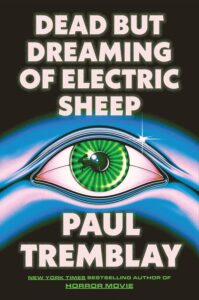 Dead but Dreaming of Electric Sheep by Paul Tremblay is cyber-adjacent novel that for much of its length plays as appalling comedy. A brain-dead man has been fitted with a control device that will enable anybody with the remote to control his limbs, march him around, and make him stand or sit. Julia Flang, once a professional video game player but a washout in that career, now living the lifestyle of a twenty-something with no direction and no way out, is brought in against her better judgment for what turns out to be the assignment of handling that control, as she shepherds that man to an airport, gets him aboard a plane, navigates a mid-country connection, and then delivers him to another airport on the other side of the continent.
Julia is a vivid and funny character, an attitudinal young woman with a nearly obsessive connection to The Big Lebowski, which she quotes constantly and most often appropriately, her sense of humor growing more savage as she comes to see the appalling inhumanity of this and hate the people (including her own mother) who have brought her into this assignment. It’s impossible, I think, to not love her, especially considering how maddening the job of wrangling a cyber-zombie turns out to be. The parts of the novel that cover her air journey, which is almost all of her part of the narrative, are a marvelously well-choreographed assortment of physical business, thought out in exhaustive detail, as Julia has to get her charge, who she has named Bernie (after the dead man in the terrible but perversely popular film Weekend at Bernie’s, in which an actual corpse is manipulated for days to hide its death, all during hot weather), around obstacles and past physical challenges, all while maintaining a steady internal monologue about her predicament. It is a juggling act for Tremblay, which he is up to.
Alternating chapters relate what’s going on inside Bernie, who at first is nearly mindless, but throughout the book is driven by a variety of stimuli to awareness of his own situation. This is at first maddening, as this man has no idea who he is or what he’s doing, only that he’s being controlled against his will as he’s navigated through a landscape that, for a long time, he can only interpret via whatever fractured, cartoonish metaphors his mind can think of. It becomes clear that he’s not alone in there and that whatever’s with him wants to know that there’s no happy destination. All he knows is that he must find “her,” and this is the big mystery of the novel, an obsession for a man on what to him seems like a journey through hell.
(So, yeah, maybe I am reviewing Obsession and Backrooms after all. The novel is driven by the first quality, and half of it takes place in corridors and surreal places, like the second.)
Tremblay here exercises a gift that he has employed in a number of his prior works, the ability to link cosmic and sometimes apocalyptic events against the most intimate of human terms. Here, a novel with a remarkably witty heroine cracking wise to both the bureaucrats she despises and in the silent spaces of her own mind, that seems like a comedy for long stretches, ultimately broadens to catastrophe while also—simultaneously!—narrowing the focus to the greatest pain this man has ever carried with him. It becomes the psychological horror novel you expect a work by Tremblay to be. I note that it’s filled with typographical tricks, like text that pops up and interrupts whatever else is being described, and several consecutive pages of the same three words, displayed in headline sizes. This is gimmickry, but I promise you, not just gimmickry; it rips through the visual limitations of the printed page, and underlines two separate armageddons, the personal and the global. It is a genuine tour-de-force and it deserves all the things.