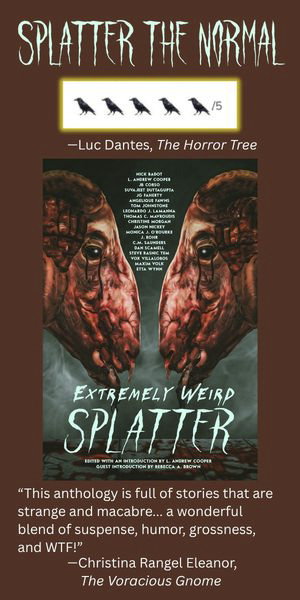
CW: blood, racism, death, abduction, abuse, sexual assault, torture.
“Their place of domicile is filthy in the extreme, and to a degree that cleansing is impossible except by the absolute destruction of the dwellings they occupy. But for the healthfulness of our climate our city populations would have long since been decimated by pestilence from these causes. And we do not know how long this natural protection will suffice us.”
Anna is breathless when she delivers us the news: Have you heard? A man has been discovered in Chinatown with the black boils of plague all over his body. One of ours.
I thread a jade hairpin through my carefully knotted hair and tell her not to call him ours. We are Orientals too, but his sort belong to the gutters while we serve the highest parlor house in Chinatown.
Vigilante
Your companions drag the coolie girl to her feet. Some two-cent girl with rags for clothes and hair hanging across her face in tangled strings. Her eyelids flutter but do not open, revealing only the white crescents of her sclera. Blood trickles from a gash across her forehead. The ragged skin sickens you like the Devil. Her skull peeks through.
This is a lynching. This is justice; science; the duty of all men in this modern age to make the unknown into the known. Nine in ten cases of venereal disease in the city come from Chinatown, that’s what the esteemed doctor said when he stood upon the floor before Congress and explained why the chinks need to be deloused from your city of industrialists and gold rushes and golden poppies.
And that was before the plague.
Wake her up, you bark at your companions. You barely know them. You recognize them from the meetings you all attend every week, but little links you besides a common outrage that the boys of the Chinatown squad are not acting enough to extract the root of the evil. That the mayor cares too much for the city’s business interests to place a proper quarantine on the Orientals.
The elite would poison the rest of you for cheap coolie labor. But you do not have to bow beneath the boot on your neck.
One of your companions, the one with the Workingmen’s badge, cuffs the girl hard enough that her eyes fly open. She cries out. The sound echoes down the alley. The shapes slumped against the black-streaked walls barely stir; the passersby at the alley’s mouth do not even offer a turn of their heads. You didn’t think they would.
The girl presses her lips together. The moonlight cuts severely across the grey dirt, red blood of her face. Her clothes are half torn from her starved frame. She reeks of urine. Sharp, tangy.
Tell me how you Mongolians cast a plague upon our city, you say.
I don’t know, she says. I know nothing.
You draw your knife, because she must be lying—men and women are languishing in hospitals, you’ve seen them. The blade is red from rust and dried blood. She pales. She babbles: It must have been the gods. There must have been a shaman trained in the old rituals, and he must have called down one of the gods to curse the city. That is why it struck so suddenly. It was the gods.
But it was a chink man who died first, you say. Why would your gods have brought the plague upon one of his own idol-worshippers?
I don’t know. I was stolen from Canton when I was a young girl, the gods and their powers are not familiar to me.
If you were stolen from Canton when you were young, how can you vow it was the gods who brought this upon the city? Tell me.
I don’t know. I don’t know!
She says this again and again. Even when you open her flesh in a dozen different places, she still does not know. Ultimately, you are asking for reason from one incapable of it. She is more raw, red meat than human, and an Oriental whore otherwise.
This one is useless, you tell your companions. An addled, filthy two-cent girl. We’ll find another more willing to talk. Maybe we’ll get more luck from a John Chinaman. But keep the body, and keep the blood inside the skin if you can. We’ll soon need it.
• • • •
My patron is late tonight. I rearrange the opium set for the third time as I wait.
The opium pellet, freshly packed, rolls roughly between my fingers. I wipe the grey residue off on the inside of my sleeve before recentering the pipe. Even from my room’s perch upon the third floor, the shouting outside is louder than the delicate scrape of the bamboo against the wooden tray, and I wonder if my patron has been waylaid. But Madame said he would come tonight, and Madame is never wrong.
I refit the saddle onto the pipe for the fourth time.
Eventually, the door creaks open, and I greet my patron with a smile. He is one of the gentlemen, with enough money to pay Madame for anonymity and exclusivity. I try not to stare at the moths gathered over his tailcoat and neck, silvery grey over every surface of him. He would ask why I am staring and I never know how to explain to people that they are covered in insects who crawl across them as if searching for some hidden pocket of sweat and fat. But my stomach twists greedily. Madame only fed me rice and bean paste for dinner, not even half a bowl. I force myself to look away from the silver moths and into my patron’s blue eyes.
Lonnie, he says. It is good to see you.
I have been waiting, I say, playfully, so he knows I have missed him. He sighs when I cup my hand against his cheek, and I know he has missed me too. The moths take flight before they might be crushed beneath my palm. His gaze does not follow their movement. He is watching me.
I’m sorry to be late, he says. There was trouble at the quarantine lines.
I do not ask what kind of trouble. He wouldn’t want to talk about it to me, and there is only one kind of trouble at the quarantine lines these days. One of our own—a Chinese fool—must have tried to step from Chinatown to the city beyond.
You are worried, I say. I see the journey has been hard on you. You needn’t be worried, not here. Outside it is loud and terrible and pungent. Here there is teakwood and bamboo, here there are colorful hangings and couches of red velvet, here there is sweet opium relief and the soft scent of my perfume when you crook your neck against me just so. My love, sit against the embroidered cushions and I will pack and light your pipe for you. Let me play my zither for you.
My patron’s eyes flutter closed, lulled by the music and the clouds of white smoke. His moths open and close their wings languidly. I perform my calligraphy for him, and he comments on the exotic curves of my strokes. My gaze drifts to the soles of his shoes, and I cannot help how my eyes search for any smudge of red. He crossed the border to come here tonight.
When Peony first told us that a group of men from the Workingmen’s Party dragged Chinese from their beds and used their blood to paint a border around Chinatown, I had not believed her. I had even laughed as she told me that white men could cross back and forth but Chinese could not. How could blood hold such a power? Then I heard about a cigar factory worker—one of our own—who burned alive when he stepped over the scarlet line and I was sorry to have laughed.
So, quarantine: penned in by Stockton to the west, Broadway the north, Kearney to the east, and California to the south. Because the plague came from the East, from Hong Kong, and it is a Chinese plague, it is a plague of the Orientals and our unmitigated degeneracy. It incubates in our filth. Best to contain it to the immoral quarter, then. It would be a mercy to the servile race to exterminate us.
When my patron has his fill of the music and the opium and the wine, I lead him to the bed and take him into me, let him take me between his teeth and press my wrists into the silk sheets. The moths startle and hover above us, as if shielding our coupling from a particularly clever onlooker. I make loud, encouraging sounds. The unluckier moths smear silver into the silk where they are crushed between his weight. He comes quickly and sleeps easily. The moths resettle across his limp form.
When I am sure of the consistency of his breathing, I pluck a moth venturing into his ear and place it in my mouth. Usually, I try to bite down on the bodies so they have a quick death, but this time I miss and sever the wings instead. The insect wriggles against my tongue before I finally find it between my teeth. I feel its panicked skittering in my mouth long after I swallow.
Tonight, I am prudent. I only take the one. I wipe the silvery dust from my teeth before my patron wakes.
Gambler
You step across the scarlet border and wonder what wickedness possessed the men to draw it. It stretches up and down the block as far as your eye can see, bright as a scar. It never dries, wet and red even after a day beneath the sun’s persistence. Neither do the rains wash it away. You take care not to stain your shoes. God only knows you cannot afford another pair.
Those men replenish the border every night. They will be coming soon with their buckets, which often have bone splinters and hair and dark marrow swimming in the blood. You’ve never had the stomach for such sights, so you hurry down streets thick with the scent of incense from the joss houses, smoke from the sizzling grills, the street vendors with their crackling oil. You tense at every sound. It could be a hatchet man, it could be an opera player. Every corner and every block is a toss of fate.
You finger the dice in your pocket.
The papers say here’s the cesspool of the city, your mother says it’s a sure way to a quick death, and you take a perverse satisfaction in reveling that you are braver than them. You cede no fear to the plague. You understand its odds better than the rioters. You’ve seen the signs; they send shudders down your spine. REMEMBER JUDGE LYNCH and 6 FEET UNDER, 0 TRIAL, 1 BULLET and THE CHINKS ARE THE DOGS OF THE CAPITALISTS.
And, of course—THE PLAGUE COMES FROM CHINATOWN.
But no other venue in this city, not even rickety dens along the Barbary Coast, gets your blood hot like Tommy’s gambling house. The Oriental guards recognize you. They smile their peculiar smiles and let you through the stout, iron-covered doors into the revelry beyond.
You love to play tan. It’s a bad vice, your mother always tells you, bad as brandy or opium, but you swear the game transports you to another realm where happiness is as slippery as a card in a dealer’s hand, as novel as the emperor grinning his panther’s smile up from the card’s back design. There is a plague outside; nothing terrible can exist within the walls of this den. Prostitutes play and they drape themselves over the gamblers. You accept a pipe still wet from the last mouth that sucked its smoke. This place isn’t clean but neither are you.
• • • •
I never learned the name of the girl who taught me to see the moths. I met her when we were numbers, or else the little one or the one we pulled from the coal barrel, huddled in the Queen’s Room like orphans in the cold. Her family had been silk farmers back in the Celestial Kingdom. They had an affinity for silkworms and the creatures they grew into.
As the rhythm of the auction pounded in the paddock outside—four hundred for this one, straight from Canton!—she taught me to tilt my head to find the correct angle of the light, to trace the outlines of wings and antennae; she said her family learned the trick over centuries of serving the high courts and the traders. It kept their patrons returning. I thanked her for teaching me. Then they took her away to have her legs forced open and her maidenhead examined by a doctor, and they took me to another room for the same. I looked for her when they led me to the paddock, but I never saw her again.
In the evening, we are a parlor house but during the day, we are a laundromat; the men who work at the garment factory down the block give us their dirty clothes at dawn and we give them back clean at dusk. The men spit on us for opening our legs to the whites in the same breath they ask us to scrub their shirts with extra diligence. We bow our heads. We pass their coins to Madame.
The girls are whispering today as they bend over their buckets and their washboards. I keep my head down, I submerge a man’s changshan and pretend it is his head I am holding beneath the water, but then Anna dips her head close to mine and I cannot pretend I am not listening anymore.
Lonnie, she says. Lonnie, have you heard?
What is it? I say. Cigar stains mottle the shirt I am washing. I grind my knuckles into the washboard’s unyielding ribs and do not wince. Madame will strip the callouses from my hands later. The water of my bucket has turned a muddy dark, entirely the wrong shade of grey.
Anna says, Peony is saying we could stop the lynchings; she believes we could stop those terrible men coming into Chinatown at all.
How? I say.
If they can use our blood to trap us in, we can use their blood to keep them out.
As if it is so simple, I tell her.
Borders are simple. They are imaginary until someone bleeds; then they have teeth.
Real enough to burn a man from the inside out.
Yes.
I laugh. It is not so easy to get a white man’s blood to paint with.
We all have clients, she says. We give them our bodies every night. Why shouldn’t they repay us?
You cannot truly believe you might bend the city to your will.
Lonnie. Lonnie, please. You could be a great help to us. We shall act during the next full moon, when the night is bright and we won’t be lost. Your client is not a good man either. I can hear you sometimes, the walls are not so thick and I know—
No, I say. Anna uses we as if we are one body, as if we do not compare the prices we fetched at the Queen’s Room every time a new girl comes in, as if we do not use our meager earnings to bet who will be the next one deemed too old and thrown out to the cribs.
Lonnie—
I shake my head. No, there is only a year left of my contract with Madame, but if I am caught, it will be another five. The men only take the girls who make their living in the streets and alleys; they do not take those who take clients upon silken sheets, lullabied by the notes of folktales in the old tongue. It is not right, and it does not feel good to the spirit to do this, and I know that May has not heard from her brother in days and she is so worried it is his blood slicking the streets, but it is how we survive.
Wife
Every night, your husband ventures into the Oriental Quarter and returns with blood on his hands.
Your sons are asleep beside the stove when he returns. The winter is bad this year, biting as an alley cat. Your sons always complain when you have them strip every night for you to inspect. You let them grouse; you press your fingers into every stretch of loose skin, inspecting them for the dark boils of the plague, tensing at every shadow, breathing a sigh when you find their skin unblemished. Clean. Safe. For years, you have instilled into them that they are not to slot themselves into the Oriental girls, that venereal disease can spread if they even touch those slant-eyed heathens. You have been so careful. And now there is a miasma snaking through your streets: a monster from which you cannot protect them.
Though, your husband can. Your husband does, every night.
He closes the door gently behind him, his best effort not to wake the boys. He looks tired but content. You pull his coat from his shoulders. Outside, he is the angel of vengeance, but here, he is your husband. He kisses your cheek, his jaw rough against your own. He palms your waist. You huff and tell him not to get blood on your clothes. He smiles against your cheek and says he’ll try, but it is hard not to touch you, irresistible girl.
How was your night? you murmur, and let him lead you to the bedroom. It is the only room you have; you are not rich folk. A single pallet welcomes you. You have already turned down the lanterns. Only a few blocks away, the Palace Hotel burns long and bright into the night, but you cannot even afford the small luxury of light.
Good, he says. It was an easy night.
You make a noise of sympathy. The last few nights have been harrowing; he stumbled in closer to dawn, and his eyes were hazed and you said his name many times before he came back into himself. He deserves this, an easy night. You don’t know why the city does not just burn the Oriental Quarter to ashes, why they are so willing to endanger the rest of the city by refusing to cut off the contaminated limb—that laboratory of infection—to save the rest of the body. You’re grateful your husband is willing to act the part of the surgeon’s saw.
But you don’t wish to think of that now. Already, desire coils in your belly, hot and needing. It has been a long night.
My brave husband, my protector, you whisper, and press a kiss to his wrist before dragging your tongue up his sticky palm. He groans as you take his fingers into your mouth. You suck him clean.
You chase the aftertaste, too.
God, chink blood is sweeter than your blood; theirs tastes like too-ripe fruit, the sort that bursts when you dig your fingertip into its skin, sticky juices dribbling down your skin. It’s all the opium, that saccharine sugar-powder.
Before you were the wife of an angel, you were a starving girl who ate rotting cabbage heads and slurped up the yellow-green guts in discarded Dungeness shells. There is a sweetness to decay. You know you shouldn’t swallow the blood, that it might have opium or plague in it, but you cannot resist.
• • • •
Tonight, my patron brings me jewelry.
The gold chains glitter prettily on my wrists. My patron shimmers moth silver all over his body. He tells me that these bracelets are from India and Panama, that I am wearing the splendor of temples. I clasp my hands and thank him and tell him how I will wear these always and never unclasp them. He smiles and sits upon the bed and gazes up at me expectantly. He does not blink when a moth skitters across his eyes. He has forgotten I do not like gold.
Even so, I oblige, lowering myself onto his lap. From the resolution of his arm encircling me, pulling me closer, I do not think there will be calligraphy or music tonight. The moths flee, but the wrongness of the jewelry makes me uncharitable. I catch some in my mouth, my tongue crushing them against the roof of my mouth so the silverdust doesn’t mar my smile. A leg wedges itself between my teeth, but there is nothing to be done about it.
A last moth with a creased wing staggers across the columns of his neck. I lower my head, lave my tongue over those delicate columns, and capture that straggler too. A groan lodges in his chest, more visceral than the sounds he made when he pushed into me the last time. He fists my hair violently, like some common boy. When I draw back, his eyes gleam like new quarters.
Please, he says. Please, Lonnie.
Warmth thrums in my blood. I taste metal in my mouth. I remember the girl in the Queen’s Room pointing out the silver fuzzing the men who lifted and lowered their hands to the auctioneer’s tempo. The warlords in the high courts, the gentlemen of this country’s new elite, they all have so much excess, they all have so many moths.
Will you grant me a favor, I ask my patron.
Of course, he says. Anything you want.
Hold your breath for me, my love. Imagine a clot of moths sits in your throat, and you cannot breathe around them. Yes, like that; perfect, my love. Lie back against the silk. You have had such a harrowing day.
When I am satisfied that no air passes through his lips, no air shudders down his windpipe, I unbutton his shirt and pull his pants down his hips. His skin is desire-hot. The blanket pools on the floor. I lower my lips to his chest, trace down his stomach. I wrap my hand around his stiff cock. He remains still. Obedient.
It is disorienting to toss the sheets with somebody so unresponsive, but he cannot help it.
With all the invisible moths in his throat, he cannot suck in a breath, he cannot let out a moan; it all collects beneath his skin, bulging like an overfilled bladder. He struggles for air loudly enough to be heard through the walls. His eyes are bloodshot. This is why I usually wait to eat the moths until he is asleep, when he cannot be commanded and cannot tempt my cruelty.
I lick down the crease of his hip.
His face is turning the color of a bruise. A plea whistles from his lips, but words starved of air are only noise. His eyes shine with tears, with a prayer. For a moment, I contemplate leaving him to choke on half-shaded moths; but then, I would have to admit I am angry enough to kill, and I told Anna I am not. Anger is for the two-cent back-alley girls who have nothing else to burn at night for warmth.
So: breathe, my love.
He collapses, clutching his neck as he gulps for air. I run my fingers through his hair and coo sweet nothings. He falls asleep in my lap with tears leaking from his eyes. I continue stroking, occasionally picking off a moth to grind between my teeth; beneath the silver tang, they have an earthy undertone, like sesame. My wrists gleam gold. My annoyance simmers still.
Half a century ago, Chinese tea was traded for British silver; then Chinese tea was traded for British opium; and then came the warships. Not very long ago, Chinese men—my cousins and uncles in their ranks—crossed the salt to mine the gold threaded into California’s branching veins; they called San Francisco the Gold Mountain City; they spoke of wide open fields of golden poppies. And now men with long knives say we are only vermin who cannot stray outside the quarantine they have made for us.
Yet I am here, silver in my mouth, silver on my lips, silver-eyed man beneath me. I look at his pale throat and think: How easy it would be to cut it open. It has already proven itself to be fallible.
I pluck another moth from his hair when he stirs, groaning.
He will not remember this in the morning. He never does. But when I examine my own reflection, my eyes are not so slanted and their color is closer to blue than black, and that is how I know I mustn’t take too much of him into me again so soon.
Bohemian
It’s a beautiful place, the Oriental Quarter.
Armed with a hand camera, you step over the line of blood and into a fantasy kingdom. Strings of colorful lanterns bow between buildings; the unfamiliar aroma of ginger from street grills coils up your nostrils; men with long braids bark orders at each other in a harsh-syllabled tongue. The sun is setting, orange light over grimy walls. Grocers pack up their wares. The quarter is dismantling itself.
You walk, recording what you can in your notepad and your hand camera. You want to bear witness to this moment. You secretly think it would be poetic, to be struck down by the very plague you wish to memorialize.
Tourists used to flock to your clubs and beg one of you bohemians, well versed as you were in the eccentric customs of the Orientals, to lead them through the authentic heart of Chinatown, the tucked-away opium dens and strange foods and unsavory back alleys that the Palace Hotel guides are too proper to show. But when the quarantine was put into place, the tourists dried up; the Oriental bazaar’s patrons have gotten sparse. All the better for you—now the premodern quarter’s sights are yours alone to appreciate.
Once, one of your journalist acquaintances insisted in a voice shrill enough to pierce glass that you are endangering yourself, asking for plague to enter you. You inquired what she’s asking for when she lets her husband, the known lord of syphilis, enter her every night. The other literati laughed.
In any case, the language of endangerment—it is only loud rhetoric from worker men bitter over the industriousness of the Chinese.
A voice behind you grunts at you to move. You know the man it belongs to, and you know his two companions. One of your fellow Bohemians wrote an article condemning the brutality of the border-painters, and the city’s inaction—but then, the city was also inactive when unionists threw vulcanite bombs into laundromat windows, and when slave catchers sold the coolie girls back to the tongs who trafficked them. There is not enough space inside you to hold all your shame at what your people have done to this quarter.
You step to the side. The men murmur their thanks. They are dragging a body between them. The girl has been hog-tied.
She’s a gruesome sight. A tapestry of bruises stretches across her neck. Her clothes have been ripped from her body, and angry blisters mar the gentle landscape of her nether parts. Nausea settles in your stomach.
You lift your hand camera.
• • • •
The days until the full moon whittle down quickly. Anna gives me meaningful looks every time we wash the laundry close to each other or when our patrons both retire early. I always look away. I temper my appetite and do not eat my patron’s moths until he is asleep, and never more than five. I think about the days I have left in my contract, and how I will soon be free of this place; I have not fallen sick in all my time here, so there will be no extensions on my contract. When my patron is asleep, I steal to the window and shift aside the curtains, and sometimes I see dark figures passing below. I never peer hard enough to see what they are carrying.
This time, Anna is weeping when she delivers the news: Peony is dead.
Plague? I ask, because I must be pragmatic even as my hands tremble and my eyes warm. Or was she stolen by the bloodsuckers?
Anna shakes her head. She says, Peony’s client thought she sprinkled something wretched into his opium. Said he couldn’t get hard with his own wife. Said Peony must have given him venereal disease too. So he strangled her in her own silks.
When I tell the story to Madame, I should not be surprised that she only shrugs and says that Peony was getting old anyway and thankfully there is newer, softer meat to fill that room now. How could she be revenged, in any case? The laws and courts do not extend into our borders. No crime was committed.
But Madame, I say.
She peers at me. You’ve always been virtuous, she says. I’ve never needed to punish you before. Don’t give me cause.
My patron comes to see me and he will stop if you lose me, I tell her, because it is true, because no other girls here can see the moths. No other girl has taken his moths into her mouth.
She slaps me.
I sold Peony’s body to the men drawing the borders, she says. I would do the same to you.
The next day, highbinders drag a new girl to our parlor house. Only May asks her how much she sold for. None of the rest of us offer up the prices we fetched. Madame guides her to Peony’s old room and she begins seeing Peony’s old patron on her first night. She cries as she scrubs the laundry the next day.
Still, the moon waxes, and I write; unlike two-cent girls who may live their entire lives without recognizing the letters of their own name, their fingerprints on the signature lines of their slave contracts, parlor girls are trained in reading and writing to display their calligraphy. So I rip apart a paper screen, and I write every terrible thing I wanted to say. I admire the shape of my anger. Blood, justice. I test my hairpins to see which is the sharpest. On the morning before the full moon, Anna looks at me and I hold her gaze.
Greencoat
You pass through the streets of the Oriental Quarter like a specter. The moon is full tonight. Your shadow stretches across the stained streets. Gambling halls bolt their doors when they see you. Urgent voices escape opium dens. You have no doubt they are setting their trap doors into motion, scuttling into their subterranean worlds. Like a flock of startled sparrows.
Your betrothed was devastated when you were assigned to the Chinatown squad. She doesn’t think it’s a respectable assignment, and makes sure you know that every night; you were trained in the baton and pistol to defend the city from wrongdoing, and here you are, corralling coolies, pacing the streets at night in case any of the tongs get too happy with the gunpowder. The mayor believes them a stain upon this city’s claim to golden progress. Your chief has saddled you with the burden of stopping them.
The mayor wants you to put a stop to that blood-painting, too, your chief said, not sounding particularly sincere. Old Jackson probably figures he won’t be reelected if this continues.
But you’re grateful for the Workingmen. When you see three of them stalking toward the parlor house, the one with the girls who dress in fine silks and giggle over their four-inch feet—as if they are better because only the bosses and tyrants of the city can afford to fuck them—you don’t reach for your club.
The Workingmen’s boots scrape against the grimy cobblestones. Their bucket squeaks. Its hinges must have rusted, reddening like a blushing girl. You wonder if they’ll be so daring to take one of those expensive girls tonight. The idea amuses you. Does parlor house blood make for a better border than whore blood?
You are supposed to prevent violence. But the coolies are supposed to be grateful guests in the land of America, and they have not been. They came without invitation, they came before the borders of this nation could be properly considered, and they do not build families but instead amass wealth to be brought back to the Oriental Kingdom.
So you let the men pass.
• • • •
I did not come to America willingly. I was sold. My father told me to hold his hand and not to let go, and then he led me through the village to the procurers waiting beside their wagon that smelled of the sea. When I close my eyes, I can still taste the flower fish barrel they stowed me in for the voyage.
The moon shines bright and full, cleaved into fourths by the window pane.
Tonight, I ask my patron to tell me again of his work, how he is a distinguished doctor who is often consulted in determining the city’s healthfulness. He tells me what I am made of and what he is made of. His organic structure is less prone than mine to disease. I steal moths from him as he speaks. Then I suck him until release and when he is asleep, I pick every last moth from his body until all those crushed carcasses sit heavy in my belly and I feel them rising up my throat even as I swallow a new one down. Even when I am done, phantom legs skitter against my throat.
It’s a necessary discomfort. The borders are not real until they are bled upon. The moths are not real until they are eaten.
Wake, my love, I say.
When he opens his eyes, they are whiteless, puddles of molten silver. He gazes at me as if I am divine enough to don the moon as an evening shawl, as if he would obey any command I give him. When I look into the mirror, my dark hair drapes over blue eyes. My mouth is the same, small and secretive. My jaw is stronger, stubble breaking through the skin. My feet are not bigger. My hands are too large for me to hold my calligraphy brush comfortably. How much of him is inside me now—how much of my organic structure has transformed into his?
He looks at me with no less adoration.
Oh, soft, strange thing. Come with me. Here, through the discrete staircases Madame uses to spirit away the esteemed gentlemen or hide us during the greencoat raids. The moon is full and lovely tonight. Hold my hand and do not let go.
We escape the parlor house with little trouble. The streets are empty now—no more gamblers stumbling in from the Barbary Coast with mouths wet from whiskey, no more beleaguered factory workers clamoring for a space at the front of the peep shows. Everybody has heard too many stories of the bloodsuckers who prowl.
I clutch my hairpin tightly.
I lead my patron onto the main street. We cling to the shadows, and he clings to me. Somewhere, a crow caws, a stark sound in the empty night. Moths circle the lone lanterns, but my stomach is too engorged for them to stir my hunger. The last time I was here, my hands were tied and I was weeping too much to even see my feet in front of me. But now my feet are unbound. Now I am the captor leading a captive.
For a moment, I almost believe that this can happen: that I can walk him to the edges of our quarter, bleed him dry, and carve my own scar into the flesh of the city. Any white man who crosses the border will burn alive. They will leave us alone. We can bargain a better future.
Anna? I call.
I barely have time to hear the heavy footsteps behind me before rough hands grab my arms, twist them behind my back. My hairpin clatters against the ground. A scratchy cloth smothers my yelp. Rough fingers tilt my face up. I look up at you.
Vigilante
Your companions cut my throat and open the artery in my leg, bleed me mostly dry. You’ve honed a craftsmanship efficiency now; when the gush slows to a trickle, you toss the body—my body—and get on with the night. The border awaits.
Are you sure, your Workingman companion says. There is something strange about her face, look.
Yes, you say. If a freak show girl tickles you, I’ll buy you a ticket to the world fair when this is all over. But blood is blood.
Gobs of it slosh onto you as you empty the bucket, repainting the line as you do every night, returning my body to the city that has so loved to indulge in it. You want to return to your wife and your sons, and you work at an animal efficiency. In the moonlight, the liquid looks silver. You do not cast a second glance at the face that has features like yours stitched atop its Oriental canvas.
You should have.
When you step back over the border, the taste of hot metal explodes in your mouth, and you gag. Beneath it, an earthier taste, but you do not recognize sesame. You bend over. Your blood warms as if something is kindling—as if a hundred thousand moths flutter beneath your skin.