CW: bodily harm and blood.
The girl is distraught, but the OB-GYN assures her some body hair loss is a common stress response, especially after trauma. Peering at the girl over half-moon glasses, the doctor cautions her that it might grow in a little thicker, but the girl hears thicket, like the untrespassable patches in the woods. She nods anyway—sure, fine; whatever. The girl just wants this exam to be over so she can put her clothes back on and go home. There’s a chemistry test tomorrow, and while she is preparing for that, she won’t have to think about this.
• • • •
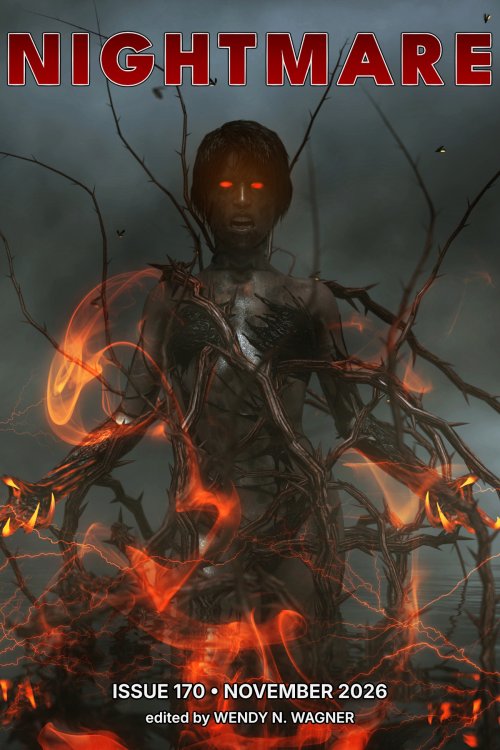
It does grow in thicker. Fibrous tendrils weave themselves into a dense tangle of undergrowth. Each strand is studded with bony spikes like thorns, long and spindle-sharp. The girl stares at them, enchanted. She cannot help reaching down to touch one, nor can she tear her eyes away from the tiny blood rose that blooms on her fingertip.
A curious coldness floods out from the point where she pricked herself, numbing her hand and surging down her arm to the shoulder. Before oblivion fills her completely, she uses her good hand to raise the wounded one to her mouth. The moment she licks the blood away, the cloud of icy fog inside her dissipates. She is alert and refreshed. I will need some new underthings, she thinks. What is the toughest fabric? Denim, or maybe canvas . . .
• • • •
The graduate student awaits the final result in the series of clandestine tests she has been running on her department’s advanced spectroscopic and chromatographic equipment. She only ever sneaks into the laboratory after ascertaining that Dr. Prince’s assigned parking space in the faculty lot is empty. Having heard the whispers, she has no desire to find herself alone with him.
But this is a warm evening, when many professors who live nearby have left their vehicles in their garages and are looking forward to a leisurely stroll back home after finishing their business on campus. The machinery clicks and whirs as it processes the graduate student’s samples. Over its white noise, she doesn’t hear the approach of corduroy-clad thighs rubbing together, a sound like a fly unzipping over and over.
When the test concludes, the graduate student prints the results, snatching the paper eagerly from the tray. Her research is in the field of pharmacology, exploring possible medical applications of the bioactive components in a range of venoms. These particular findings, however, will not appear in any of her reports. It’s an improper use of the lab’s equipment, serious enough to get her dismissed from the program if she is caught—but she has to know. She skims the printout, confirming her hypothesis: a sedative powerful enough to induce a coma, and an antidote that completely reverses the toxin’s effects. Both from a single organism. The affliction and the cure, she marvels. Curse and counter-curse.
A hand with a glittering ring on the pinky starfishes against her lower back. The graduate student jumps, and the paper she was holding flutters to the ground.
• • • •
The trickster-hero is lucky; she meets no one in the hallway as she wheels a coffin-sized crate on a dolly to the rickety service elevator. The ride to the sub-basement is a thrilling series of drops and jerking halts, like being lowered clumsily into a well in an old bucket.
When the doors creak open, she guides the crate out of the elevator and wheels it through a labyrinth of mouldering file boxes. Eventually she comes to an antechamber with a low, arched doorway, a relic from a more primitive era. Part of the wall has crumbled into rubble, and the trickster-hero kneels to arrange some of these mossy boulders around and over the crate. By the time she finishes, it looks as if it has always been there.
Smiling, she stands and wipes her hands on her cargo pants. “Perhaps I will return to wake you up in a hundred years,” she tells the crate. But she is careful not to frame this as a promise. Unlike the crate, she has places to go and discoveries to make. Before too much time has passed, this whole episode might be just a footnote in her life, a brief encounter with an ogre who got his comeuppance, once upon a time.
Author’s note:
I have a fascination with pointy objects, whether natural or human-made, and several versions of “Sleeping Beauty” feature both kinds. When I shifted one prickly element to an unexpected place, it changed the whole trajectory of the narrative.