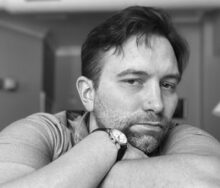
Dan Coxon has won a World Fantasy Award (Heartwood: A Mythago Wood Anthology), a Saboteur Award (Being Dad) and two British Fantasy Awards (Writing the Uncanny and Writing the Future, both co-edited with Richard V. Hirst). He has been shortlisted for the British Fantasy Awards a total of eight times, and was a finalist for the Shirley Jackson Awards. In October 2025 his anthology of haunted house stories, Unquiet Guests, was published by Dead Ink Books. His second short story collection, Come Sing for the Harrowing, will be reissued by CLASH Books in April 2026, followed by a brand-new novella, Where Once He Stood, published by Black Shuck Books in May.
Thanks for doing this interview! Could you introduce yourself and what you write for those not yet familiar with you?
I’m a British editor and author, leaning towards horror and weird fiction but by no means confined to it. My anthology Heartwood won a World Fantasy Award last year, and that was inspired by Robert Holdstock’s Mythago Wood fantasy series—although I’d argue that particular series has plenty of folk horror in it too! I also co-edit a series of essays on writing with Richard V. Hirst, which are published by Dead Ink Books. The first of those, Writing the Uncanny, is still taught on several creative writing courses, and probably best sums up my preferred tastes when it comes to my own writing—weird fiction with a healthy helping of horror on the side.
Come Sing for the Harrowing is such a fun, creepy, gross (in a good way), and horrific collection. Could you give us a quick pitch on it?
A lot of the stories in that collection are me trying to do a very specific thing, namely reimagine folk horror through a more contemporary weird fiction lens. Don’t get me wrong, I love traditional folk horror—but I feel that it’s in danger of burning out, Wicker Man-style. I wanted to see what happened if you took some of the classic folk horror tropes and dealt with them in different ways, maybe modernized them, or combined them with other horror subgenres. I’m aware that probably sounds like a rather dry, academic exercise, but that was only the starting inspiration! I hope there’s plenty of humor in there too, and a few full-on horror set pieces. I’ve also mixed in a few stories that are less folk horror: There’s a Lovecraftian story, a story inspired by Shakespeare’s King Lear, and a couple of haunted object tales.
One reviewer has said she liked the fact that you could never tell where each story was going to end up—and if I’ve achieved nothing else, then I hope I’ve achieved that.
You’ve been the editor for so many different anthologies. Did your editor side come out when selecting the stories for Harrowing?
I love putting stories in sequence for an anthology or collection, whether they’re mine or other people’s. I always find it’s at that point when you start to really see it as a book—until then, they’re just a bunch of disparate stories. Once you begin to put them next to each other, though, the magic starts to happen. Some stories really spark off each other, while others are too similar and need to be kept apart. With both collections and anthologies, I believe that there’s a sequence which shows off every single story in its best possible light—it’s just a matter of moving them around like jigsaw pieces, discovering what’s working and what isn’t. It’s one of my favorite parts of the process.
You have a foreword written by the great Brian Evenson greeting readers when they open Harrowing. Could you talk about how that came to be?
Brian’s been a wonderful supporter of my writing for a while now. I had to check back through my messages to confirm this, but it started five years ago, in 2021. He bought a copy of my micro-collection Green Fingers from UK small press Black Shuck Books, and sent me a message to say how much he’d enjoyed it. We’ve messaged each other occasionally since then (he contributed a story to my 2022 anthology Isolation, for Titan Books), so when it came to gathering endorsements for Come Sing for the Harrowing it seemed only natural to ask him. Brian being the wonderful person he is, he asked if I’d like him to write an introduction instead of just a blurb. Honestly, I feel so lucky to have had his support—he’s an inspiration in the way in which he advocates for and lifts up the horror writing community, as well as being such a wonderful writer.
What is it you enjoy about reading/writing short stories?
I’ve become known as a short story specialist (I’ve yet to publish a novel—although you never know, watch this space!), and it’s definitely the form I feel most comfortable in. I think you can do things in a short story that just wouldn’t be allowed in longer fiction. A novel has to earn its way, with one eye on marketing trends and reader expectations, but a short story can do its own thing. I’ve absolutely loved some short stories that are quite combative and antagonistic towards the reader, almost as a challenge—you just couldn’t do that in the longer form. You’re also freer to experiment in short fiction, to leave things open-ended and unsettling (which is hugely important when it comes to the Uncanny), to write strange characters and take them to unwelcome places.
In particular, I feel that short stories are essential to the Weird and the Uncanny more than most genres. If you look at a writer like Shirley Jackson, even her novels tend to be pretty short—it’s just not a genre that lends itself to longer pieces. It’s hard to sustain an unsettling atmosphere beyond a certain point, but also the longer you run, the more the reader expects a neat resolution. The shorter form lets you leave things open and unexplained, which I find so much more interesting.
Could you talk a little bit about your writing processes for some of these stories?
I actually vary my writing process a lot, depending on the requirements of each story. I think it’s partly to keep me from getting bored—I like to feel that I’m constantly learning and breaking new ground, and changing the techniques I use and my writing processes is a way of doing that. There’s a story in this collection (“Long Gone (Slight Return)”) which was originally written as a series of interview transcripts, one for each character; then I used a cut-up technique to break these up and weave them together, so that you get a very fragmentary, nonsequential narrative. Plus I threw in some lyrics I’d written after two solid weeks of listening to early grunge albums, and an imagined gig poster. That’s the one story where you can most clearly see me playing around in my sandbox!
The one constant in my process is that I edit quite heavily. That’s no great surprise, since I’m an editor by trade when I’m not writing—but I always view that first draft as just a rough outline, then the real work begins.
Were you into horror as a kid? What were some of the stories or movies that really interested you in the genre? What are the major influences?
You know, I don’t think I was. I read some horror—mainly King, a little bit of Ramsey Campbell, the classics like Dracula and Jekyll and Hyde—but I read widely in other genres too. The same goes for films, although I actually found a lot of horror films too scary when I was young. I was the eldest of two, and my parents weren’t into horror, so anything I watched, I watched late at night in an empty house—and that’s never a great idea. What I did see, I rarely finished. That said, the two Davids, Cronenberg and Lynch, were a solid part of my teenage viewing, and I suspect both seeped into my subconscious at an early age. You can see elements of both in things I’ve written, I think.
I’m seeing a connection between many of the stories that involve the main characters having a sort of “calling.” “Bring Them All into the Light” and “The Wives of Tromisle” come to mind here. Many a horror story protagonist has had callings such as these. What is it about callings and obsessions that are inherently so ingrained within horror stories?
I’m not sure if it’s specific to the horror genre, but I love stories of obsession. Just that blinkered mindset, that determination to follow a particular path, the rest of the world be damned—that’s always interesting to me. With short stories especially, I find it’s always productive to zoom in on the one moment where your character’s life goes from being mundane and ordinary to extraordinary and strange—and that often means following them down a rabbit hole. A lot of my characters are just normal people who suddenly find their world turned upside, or have the rug pulled from beneath their feet . . . however you like to picture it. That moment of queasy intensity is where all our best stories lie.
I enjoyed the atmosphere of each story, which felt easy to slip into after the first few paragraphs. I think writing atmosphere can sometimes be a bit difficult (at least for me!). How do you usually tackle writing these sorts of aspects in your stories?
I work most stories pretty hard before I set pen to paper—by which I mean that I’ll spend days, sometimes weeks thinking them through, considering different starting points, different styles, different plot twists. Whenever possible, I won’t actually sit down to write until it’s all somehow coalesced and started to make sense in my head, and by that point there’s usually a particular style or “voice” attached to it.
That said, as I’ve alluded to before, I’m an editor by trade—so sometimes I have to make that tone consistent, or even discover it, once the first draft is done. That’s usually done by finding a specific section in the draft that I like the tone of, then trying to spread that out through the piece as a whole. (The exception to all of this is the closing story from the collection, “Beyond the Beach, the Trees,” which I wrote while listening to the White Lotus soundtrack on a loop. As I said before, I like to use different techniques for different stories, and this seemed to fit the tone I was trying to achieve.)
One of my favorite stories in this collection (“The Darkness Below”) deals with family. That theme permeates through most of Harrowing as well. What is the inherent horror of family for you?
My family are lovely people, so I’m not sure where that comes from! I suspect it’s because I like stories that have a strong emotional pull for the reader—not just stories that are clever or thrilling or terrifying, but ones that make you feel the full range of human emotions. Any character you write about will, presumably, have a family (or extended family), even if they’re an orphan, and it makes them seem more rounded and real to place them within that context, I think. But also that’s where the true horror comes from—not just how something affects you as an individual, but how it affects your loved ones. I have two kids, and the thought of anything bad happening to them never fails to fill me with overwhelming terror.
Outside of your various anthologies, you’ve also edited many essay collections on the craft of writing. I think it’s important to give back, and it looks like you’re doing that for the writing community with those collections. Could you talk about what the process for selecting craft essays versus selecting fiction?
Thank you—I do think it’s important to give something back. I’ve taught workshops too, and spoken at universities. I believe it’s in everyone’s best interests to have a strong and thriving community, with new voices constantly coming to the fore—and passing on the lessons we’ve learned is one way of doing that.
With the craft essays, we’ve almost always commissioned them rather than having open submissions. The reasons for that are varied (and often driven by publishing concerns as much as artistic ones), but it does mean that we’ve always been careful to approach writers who we think will have an interesting and articulate opinion. Then we simply encourage them to write about whatever they’re most passionate about—we don’t ask them to write to a very specific remit. I think that way you get the best essays out of them, because they’re emotionally invested in what they’re saying. The author shouldn’t have to worry about how what they’re writing will fit into the book as a whole—that’s the editor’s job.
What’s next for you? Do you have any projects coming out soon or that you’re working on you can talk about?
So many projects! 2026 is without a doubt my busiest year yet, and I’m doing my best to carve out some time to write too. I have two horror anthologies coming in the autumn: one is Unearthed for Titan Books, which I’ve co-edited with Philip Fracassi. Nineteen brand new tales of horror buried beneath ancient sites like Stonehenge and Machu Picchu, to name just a couple. We have a great lineup for that, including Tananarive Due and Eric LaRocca. (The other anthology has yet to be announced—but it’s very exciting!) There are two new nonfiction collections as well, including Collective for Luna Press, which is a book of essays about editing anthologies. When it comes to my own writing, Come Sing for the Harrowing is just out, and I have a novella (or possibly short novel?) coming from Black Shuck Books next month: Where Once He Stood. It’s a weird mashup of styles, from suburban crime to Satanic horror—I hope people like it. Then I should have another collection on the way, possibly before the end of the year, or early 2027. I’d best get working . . .