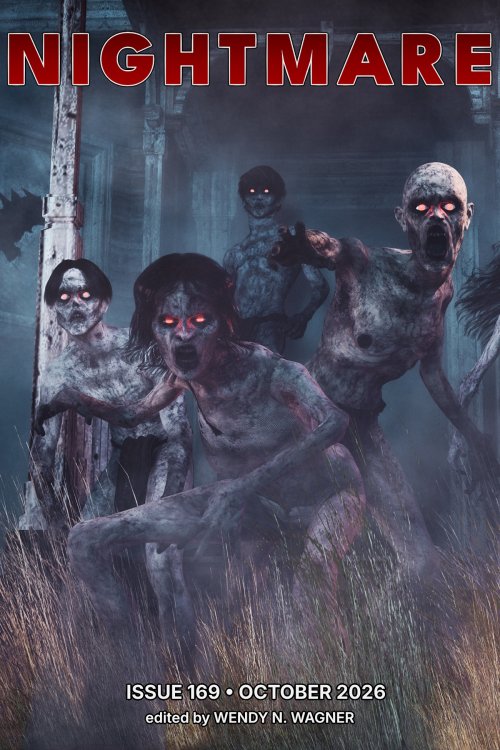
“We Are All in the Same Boat” is an insidious horror story that really feels like it has a lot to say about our current environment here in the United States. Could you tell us about the genesis of this story for you?
I live in Canada, but it’s hard to escape the politics of the United States, eh? I wrote this in September 2024, so the upcoming U.S. presidential election and what it would mean for the world was top of mind. I think I was also thinking about the interplay of climate change and capitalism, and how they affect labor and resources. Depressingly, the story’s themes have only become more relevant over the past few years.
On a more positive note, I host a monthly writing club where we create short stories based around the same prompt and read them aloud. This piece was inspired by the theme “nautical horror.” The group has been running for three years, and several of my stories for it have since been picked up for publication. (As have others—I think collectively we have ten-plus pieces published in pro and semi-pro magazines!) I would not be the writer I am today without this group and the support of my friends.
As a huge cosmic horror fan, I definitely feel like some inspiration might have been taken from the classic trope of our main character(s) mid-transformation into some grotesque, beyond-human entity. Where did you draw inspiration from with the horror elements you chose to emphasize?
It’s hard to write fish-based cosmic horror and not draw comparisons to Lovecraft’s The Shadow Over Innsmouth, but I tried not to pull too directly from it for a variety of reasons. As a trans person, I am fascinated by body horror and the idea of bodies being outside of our control. Unwilling transformation shows up often in my work. I also drew from Hiron Ennes’s Leech as an excellent example of what a hive mind’s internal point of view might be like.
However—and this is key—the big thing is that fish are gross. They are slimy and weird and I hate their creepy eyeballs. They scare me and I think they should scare you, too.
There are a lot of similarities between the ships in the story and real-life fishing trawlers, but I’m not certain if “factory ships” exist yet, where the mechanical assembly line is on the boat as well. Maybe I just don’t know much about factory fishing, to be honest! Did you have this story taking place anywhere specific or in any specific time period while writing?
They do exist, actually! Factory ships can fully process the fish onboard into frozen fillets, and often stay at sea for several weeks at a time. The ship in this story is a modern-day “freezer trawler” floating over the Atlantic. I tried to keep the setting as grounded as possible despite the surreal horror happening around it. The one thing I did change is that today’s commercial fishing industry has quotas trying to prevent overfishing rather than encouraging it. Although I’m sure I missed some other minor details that a real fisherman would catch (pun intended).
The writing style of “We Are All in the Same Boat” is very terse and didactic, which serves the themes well, makes it read dispassionately, like a quarterly report. What made you want to take this approach to the story?
Horror is the most effective when our imagination fills in the gaps, so I tried to keep the details limited and make the few descriptions as visceral as possible. I was interested in exploring a pluralistic, mostly omniscient POV, such as that of a hivemind, but I had to strike a balance between the narrator’s knowledge and keeping the reader in suspense. I settled on a terse writing style that created a detachment from character and body.
Horrible things are happening, but it’s all from a distance.
It’s extra horrifying that, from what it seems, the only woman on board is the one who a) speaks up and b) gets assimilated first. It’s framed in such a horrid way, how she’s called to the quality master’s private quarters and nobody speaks about it, although everybody knows. Combining this with the horror “transmutation” aspect of the story makes it even more salient. What made you single out her and the apprentice as our focus protagonists?
Assimilation here deliberately draws parallels with sexual assault; the focus protagonists are, unfortunately, the ones most vulnerable to it. But the horror comes for us all eventually.
The body is a political site: Issues of labor, patriarchy, economy, and climate change are all intertwined. I won’t bore you with a thesis about it, but hopefully you can see those ideas present in this piece.
The ending is purgatorial; there’s no end in sight or even imaginable for the crew of this ship. What do you think happens when there’s no more to trawl?
They come back to land, of course. They’re hungry.
I have to ask: On your website, it says you’ve “heard a prophecy about [your] inevitable doom.” I can feel the energy of that in your writing. Could you tell us more?
Unfortunately, we are all doomed; fortunately, we can do whatever we want until then. The ending of all our stories is predetermined, so it’s important to make the most of the middle bits. Enjoy your free will!
What do we have to look forward to coming from you in the future?
Someday (hopefully) a novel. In the meantime, you can find my past and future published short stories on my website: aviburton.com.